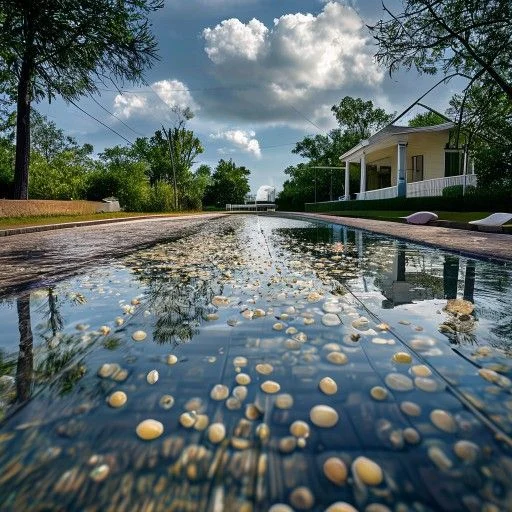
Rain and pollen are two constants of Marion County pool ownership — more influential than most homeowners realize until chemistry drifts or water clouds after a storm. Screen enclosures change how debris enters your pool but not how rain dilutes sanitizer or how oak pollen consumes chlorine. This guide explains what happens to pool chemistry when Central Florida weather hits your screened pool, what you can do between service visits, and when professional chemical service should take over.
Why Marion County weather hits pools harder than inland climates
Ocala sits in a humid subtropical zone with long summers, intense afternoon thunderstorms, and distinct pollen seasons driven by oak, pine, and grass across golf communities and residential landscaping. The Villages, On Top of the World, Stone Creek, Oak Run, Golden Ocala, Summerfield, and central Ocala neighborhoods all share this pattern — local tree cover varies, chemistry rules do not.
Screened pools receive rain through mesh roofs. Wind drives fine pollen through screens. Humidity stays elevated under the cage, keeping surfaces damp along tile and steps where biofilm forms when chlorine dips. Weather is not an occasional nuisance — it is the background condition your pool chemistry must handle year-round.
What rain actually does to pool water
Rainwater is not pool water. It is nearly distilled — low in calcium, zero chlorine, and often acidic or alkaline depending on atmospheric conditions. A typical summer downpour adds hundreds to thousands of gallons to a residential pool, diluting everything you balanced last week.
After heavy rain, expect:
- Chlorine dilution — sanitizer level drops; algae risk rises if pump does not run and rebalance quickly
- pH shift — often upward after rain; chlorine effectiveness drops when pH climbs
- Alkalinity change — affects how stable pH remains over following days
- Cyanuric acid dilution — less stabilizer means faster chlorine loss to UV on sunny days following the storm
- Debris influx — rain washes roof grit, pollen, and organic dust off screen frames into the water
One storm rarely ruins a well-maintained pool. Repeated storms between infrequent service visits compound drift until water looks cloudy.
Pollen: the silent chlorine consumer
Marion County pollen season peaks roughly March through May, with oak among the heaviest contributors. Pollen is fine enough to pass through pool screens. It collects on the surface, packs skimmer baskets, and sinks as it saturates. Organic pollen consumes free chlorine through oxidation — your test strip may show chlorine present while demand remains sky-high.
Signs pollen is winning:
- Yellow or greenish surface film after windy nights
- Baskets packed with yellow-green sludge within days of emptying
- Waterline stain that returns days after brushing
- Cloudy water despite “okay” strip readings
Professional testing measures more than a dip strip — and logged trends across visits show whether you are fighting pollen demand or underlying algae.
Screen enclosures and weather interaction
Homeowners sometimes assume cages block pollen and rain effects. Reality is more nuanced:
- Screens block large leaves and animals — not fine pollen
- Rain enters freely; sometimes concentrates runoff along screen wall bases
- Humidity under the cage slows surface drying — biofilm risk on steps
- Reduced direct sun can slightly lower UV chlorine loss — but does not eliminate it
Screened pools in Ocala and surrounding communities still need consistent sanitizer and filtration — cage type changes debris size, not basic chemistry physics.
Testing after storms and pollen peaks
Homeowners with test kits should check within 24–48 hours of heavy rain or visible pollen load — not wait two weeks for the next route stop if water looks off.
Minimum useful readings:
- Free chlorine
- pH
- Alkalinity
Professional chemical service adds consistency: same tester calibration, logged history, and adjustment within membership scope. That history matters when diagnosing whether repeated cloudiness is pollen, phosphate buildup, or filtration failure.
Practical steps after a Marion County thunderstorm
If equipment is safe and water is not already swamp-green:
- Run the pump continuously for several hours to circulate and filter
- Empty skimmer and pump baskets — storm debris clogs flow fast
- Test water once circulation stabilizes
- Brush waterline if pollen film is visible
- Do not double-shock blindly — over-treatment complicates recovery
If water is green or pump will not prime, stop DIY and request professional assessment.
Phosphates and organic load after wet seasons
Organic material from landscaping, roof runoff, and decomposing pollen contributes phosphates — nutrients that feed algae when chlorine momentarily drops. Phosphate management is not always part of basic membership but matters on pools with repeated algae despite “normal” chlorine readings.
Honest companies quote phosphate treatment separately when testing warrants it — not as automatic upsell every visit.
Seasonal calendar for Marion County pool chemistry
March–May (pollen peak): Highest organic chlorine demand; empty baskets frequently; watch dulling water between visits.
June–September (heat + daily storms): Rain dilution weekly; algae grows fastest in warm water with low sanitizer.
October–November (leaf drop): Organic debris along cage perimeters; brush waterline.
December–February (cooler + guest use): Lower algae pressure but weekend bather spikes in active-adult communities.
When rain and pollen expose service gaps
Water should recover within a few days after a single storm on a maintained pool. Chronic cloudiness after every rain suggests:
- Infrequent or unreliable service intervals
- Filter overdue for cleaning
- Inadequate pump run time between visits
- pH and alkalinity imbalance amplifying chlorine ineffectiveness
Fixing frequency or provider reliability often beats buying more homeowner test kits.
CCC Pools approach to weather-driven chemistry
We are building biweekly routes across Marion County with visit reports that log readings after each stop — so homeowners see trends through pollen season and storm weeks. We are a new company; we will not claim we have seen every storm since 1995. We will document what we test, what we treat, and what we recommend when weather pushes your pool outside normal balance.
Frequently asked questions
Should I shock my pool after every rainstorm?
Not automatically. Light rain on balanced water often needs circulation and minor adjustment — not full shock. Heavy rain with visible cloudiness or zero chlorine may need more aggressive treatment.
Why is my screened pool cloudy only during pollen season?
Pollen creates high chlorine demand and fine particulate that taxes filtration. Baskets and filters load faster; chemistry must keep pace.
Does acid rain affect Ocala pools?
Florida rain can shift pH, but “acid rain” is rarely the primary issue compared with dilution and organic load. Test and adjust rather than assuming catastrophe.
Can I prevent pollen from entering my screened pool?
Not completely. Finer mesh on screens helps slightly but reduces airflow. Management through filtration, chemistry, and brushing is the practical approach.
How soon after rain should my pool be tested?
Within 24–48 hours if storms were heavy or water looks dull. Professional route customers rely on scheduled visits plus emailed reports for trends.
Weather is constant — chemistry should be consistent
Rain and pollen will keep happening in Marion County. Reliable chemical service with logged readings is how screened pool owners stay ahead of drift instead of reacting to green water. Learn more about Ocala service areas and route availability for your address.
CCC Pools of Ocala — screened pool service team. Owner-operated routes in Marion County, FL.